Jinfo Blog
Receive these Blog items monthly, by signing up for the free newsletter:
 KM and organisational change: M&A and onboarding
13th February 2012
Onboarding a new business throws up all sorts of knowledge and information management issues. Staff from the new business will bring a whole set of information with them in a range of formats. Some of this will be intellectual property bought as an asset and could include documents on shared and hard drives, intranet or webpages, databases and subject matter experts.
Agile strategy and development
10th February 2012
In the bad old days, IT would go out to the business, write down a big list of requirements, build a shiny new product and unveil it to the business three months later with a big “Ta Da!”. Sadly, too often the outcome would be a product that fitted the initial brief, but didn’t hit the needs of the business. Thankfully we’ve moved on since then, and "agile" offers a set of methodologies used by many development teams. It is particularly prevalent in relation to collaboration tools e.g. websites, SharePoint and social media.
 Compliance - it's not just financial
10th February 2012
Businesses are more burdened with regulation than ever before, according to a new report. The bulk of the current rules may be financial but, if we’re reading the runes correctly, it looks as if privacy regulation is catching up fast.
Managing information during a period of organisational change
9th February 2012
One of the common mistakes to make when designing a KM programme is to make the assumption that your organisation will not restructure in the near future. The reality is that most organisations are in a state of almost constant change, particularly during tough economic conditions. This can have a serious impact on information management. Organisational restructures need to be reflected in URLs, taxonomies, file structures, metadata and content.
 An unconference approach can revitalise meetings and training
9th February 2012
For the past few years, unconferences have been gaining traction in everything from business to higher education. However unconferences can teach us more than how to hold a better, more relevant conference. They can also teach us how to run better, more relevant companies and organisations.
 Global thinking about local searching
9th February 2012
If you are like me, whenever you are working on a research project, the first place you turn to is one of the big three databases – Nexis, Factiva or Dialog. You know that the big three do not cover everything, but when you are on a tight deadline, you hope that a search in one of these databases will quickly and easily produce your desired results.
 Understanding the high stakes of stakeholders [ABSTRACT]
9th February 2012
Every department, and every business, has customers: the people who directly use the services of that department or business. In library and information services, we know who our customers are – those who use our services, databases and sources to get the information they need to do their work effectively.
 Managing information, opportunities and the role of info pros
9th February 2012
You probably feel you have a good sense of the assets of your organisation. However most organisations actually have no idea about how much information they have stored away, because no one has bothered to track it down and count it. This year one of my clients discovered they owned 45TB of information contained in 6000 Lotus Notes databases, but had no way of searching this vast repository. We worked out that staff time being wasted in creating information that no one could find was around €150Million a year. That was the equivalent of building 10 new factories!
 Understanding the Facebook Timeline
9th February 2012
Earlier this year Facebook launched Facebook Timeline. Timeline is a reverse-chronological display of a user's history on Facebook. This is a big issue for some users as timeline is non-optional for all users.
Register for our next Community session:
From AI use cases to implementation
22nd October 2026
Latest on our YouTube channel: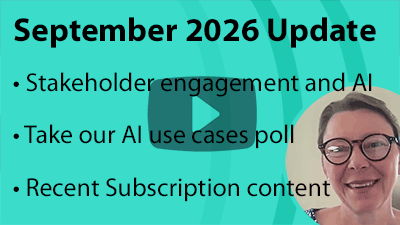
Read on the Blog:
September 2026 update
2nd September 2026
- Take our poll on AI use cases
8th September 2026 - September 2026 update
2nd September 2026 - All recent Subscription content
25th August 2026
- Jinfo Community session (TBC) (Community) 15th December 2026
- Jinfo Community session (TBC) (Community) 19th November 2026
- From AI use cases to implementation (Community) 22nd October 2026