Articles
Content
Articles that help raise the value of information in your organisation, available through a Jinfo Subscription.
 Connecting the Dots: A Semantic Web Primer
3rd October 2011
The much talked-about semantic web appears to be getting ever closer and organisations like Google, Best Buy, TripIt and ZoomInfo are already using semantic technologies to connect with users or increase their online presence. Candice Fong provides a very useful introduction to the technologies and tools, and questions whether law may benefit from the semantic web.
 In the thick of it: Why information professionals should be at the heart of government digital engagement activity
3rd October 2011
As government strives to create two-way communication with people, librarians are ideally placed, and equipped, to be at the heart of this digital engagement. Lesley Thomson describes the perfect skills government librarians have to facilitate this engagement and the value breaking into this new “information territory” would bring.
 Powering up with predictive search
3rd October 2011
One of the most difficult aspects of searching for information on an unfamiliar subject is knowing the appropriate vocabulary to use. Each sector and industry has its own terminology which can cause a search barrier for the uninitiated. Tasha Bergson-Michelson shows how to overcome this barrier through the use of predictive search which involves visualising what the answer might be.
 Product Review of Intelligence Plaza
20th September 2011
Intelligence Plaza, web-based market and competitive intelligence software that automates routines and organises data in one storage repository while enabling information sharing and delivery to end users, is reviewed by Scott Brown.
 Establishing the Benchmark
20th September 2011
Current FreePint Research projects are: benchmarking the buying patterns of UK law firms; studying copyright policies and practices; and benchmarking pricing for a limited number of commonly used products.
 Product Review of Preqin's Private Equity databases
20th September 2011
Preqin, a publisher of online databases, reports and data on alternative investments, including private equity (PE), real estate, hedge funds and infrastructure funds, is reviewed by Perrin Kerravala (Private Equity Databases).
 ProQuest Dialog for novice and experienced searchers
4th September 2011
Whether you are an old hand at searching Dialog products or you are a novice, searching methods in ProQuest Dialog™ allow everyone to achieve precision in their search results. Beverley Crane explains how this is possible using thesaurus, set searching and restricting searching in a multi-file search.
 Write here, right now - how Tumblr changed blogging: Part 2
1st September 2011
In the second part of a two-part article, Will Myddelton and Martin Belam look at how Tumblr is being used by a range of organisations, from libraries to news organisations, and how easy it is to search for niche information and follow tumblelogs.
 Some ways to use Storify - curate an archive, add context, tell a story
1st September 2011
Much of social media content is very much “of the moment” but often content is created which needs to be captured and commented on for future use. That’s when Storify comes into its own as it allows you to embed individual “units” of social media, such as Facebook updates, tweets and YouTube videos, into a single Storify blog post. Jo Brodie reviews Storify and compares it with other tools such as Chirpstory.
 Managing stakeholder relationships - the importance of cognitive behaviour
1st September 2011
Successfully managing stakeholder relationships is vital to any organisation which not only wants to grow but also retain its customers. Defining stakeholder groups and their characteristics is the start of the process but going back to the basics of human cognitive behaviour is at the heart of it. In her article, Emma Kinani looks at to how to build up communications with stakeholder groups and the impact of social media tools.
What’s inside
The method of understanding and processing information determines the outcome – the purpose of the information, decoding the message, and dissemination. Similarly, organisations can use information to steer their business one way or the other to develop a form of relationship that will ultimately lead to business growth. No matter the nature of business, it is imperative to go back to basics and formulate a model that seeks to address the underlying motive. Organisations are built by people who have vision; they have goals, dreams and personal hopes to see their business grow and flourish. Philanthropic or otherwise, the result is the same for all – to make it work! Defining the stakeholders are, and how to manage both internal and external communications to engage both groups, is therefore vital.
Teaser
Successfully managing stakeholder relationships is vital to any organisation which not only wants to grow but also retain its customers. Defining stakeholder groups and their characteristics is the start of the process but going back to the basics of human cognitive behaviour is at the heart of it. In her article, Emma Kinani looks at to how to build up communications with stakeholder groups and the impact of social media tools.
What’s inside
The method of understanding and processing information determines the outcome – the purpose of the information, decoding the message, and dissemination. Similarly, organisations can use information to steer their business one way or the other to develop a form of relationship that will ultimately lead to business growth. No matter the nature of business, it is imperative to go back to basics and formulate a model that seeks to address the underlying motive. Organisations are built by people who have vision; they have goals, dreams and personal hopes to see their business grow and flourish. Philanthropic or otherwise, the result is the same for all – to make it work! Defining the stakeholders are, and how to manage both internal and external communications to engage both groups, is therefore vital.
Teaser
Successfully managing stakeholder relationships is vital to any organisation which not only wants to grow but also retain its customers. Defining stakeholder groups and their characteristics is the start of the process but going back to the basics of human cognitive behaviour is at the heart of it. In her article, Emma Kinani looks at to how to build up communications with stakeholder groups and the impact of social media tools.
Register for our next Community session:

AI use cases
22nd September 2026
Latest on our YouTube channel: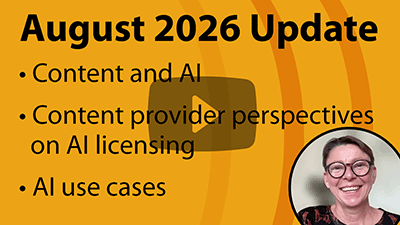
Read on the Blog:
August 2026 update
4th August 2026
- August 2026 update
4th August 2026 - Content and AI – key findings from Jinfo's recent research
21st July 2026 - Vendors and AI – integration is creating a new opportunity for aggregators
9th July 2026
- From AI use cases to implementation (Community) 22nd October 2026
- AI use cases (Community) 22nd September 2026
- Stakeholder value and AI: Workshop (Community) 16th July 2026