 The AI paradox – why trust matters more than ever
Jinfo Blog
23rd June 2026
Abstract
Item
One message appeared repeatedly at the KIMRA (Knowledge & Information Management, Research & Analysis) conference in London, UK, in June 2026:
Organisations are spending considerable time evaluating AI tools, but often less attention on the content and knowledge foundations that ultimately determine the quality of outcomes.
As organisations move from experimentation to operational AI use, trust is becoming a critical success factor.
Whether AI is used for research, knowledge management, client support, or decision-making, the quality of outputs remains closely linked to the quality of underlying information.
A new Jinfo report examines all the themes, including "trust":
- "KIMRA 2026 – Priorities for information managers in the age of AI" (Jinfo Report)
The conference highlighted three distinct dimensions of trust:
- Trust in information – AI relies on trusted content.
Participants highlighted the importance of source transparency, attribution, and the ability to trace outputs back to original information.
While many organisations have invested heavily in organising internal knowledge, there was growing recognition that trusted external content remains essential for providing context, validation, and broader perspectives.
- Trust in technology – trust in AI-generated outputs cannot be taken for granted.
As AI becomes embedded in everyday workflows, organisations need governance, validation processes, and human oversight to ensure that outputs can be relied upon.
Confidence in AI is not simply about the model itself, but about the controls and processes surrounding it, including critical thinking.
- Trust in people and relationships – trust also extends beyond content and technology.
Several speakers argued that we increasingly operate in a "zero-trust world", where credibility is shifting from institutions towards individuals.
At the same time, vendor-customer relationships are becoming more collaborative as organisations and content providers work through questions around AI licensing, access, and commercial models.
As AI makes it easier to generate content, expertise, judgement, and professional reputation become increasingly important differentiators.
Trust as a strategic opportunity
Across all three dimensions, participants broadly agreed that AI increases rather than decreases the value of trust. As one attendee observed:
"Trust is becoming the currency of both information and AI".
For information and knowledge professionals, this presents a significant opportunity.
Many organisations are rediscovering the importance of content governance, taxonomy, metadata, knowledge curation, and critical evaluation – capabilities that have long been at the core of the profession.
Trust was only one of eight themes identified by Jinfo at KIMRA 2026.
The detailed Jinfo report "KIMRA 2026 – Priorities for information managers in the age of AI" also explores:
- knowledge foundations
- critical thinking
- subject matter expertise
- talent development
- digital twins
- AI agents
- the evolving role of research teams.
... and includes practical actions for information managers. Read the report.
- Blog post title: The AI paradox – why trust matters more than ever
- Link to this page
- View printable version
 Related reports:
- KIMRA 2026 – Priorities for information managers in the age of AI
Tuesday, 23rd June 2026
Register for our next Community session:
AI use cases in information management
22nd September 2026
Latest on our YouTube channel: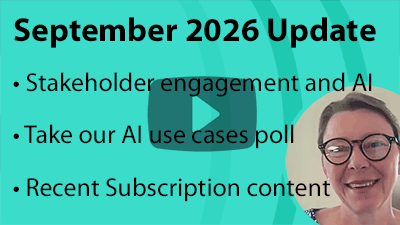
Read on the Blog:
September 2026 update
2nd September 2026
- Take our poll on AI use cases
8th September 2026 - September 2026 update
2nd September 2026 - All recent Subscription content
25th August 2026
- Jinfo Community session (TBC) (Community) 15th December 2026
- Jinfo Community session (TBC) (Community) 19th November 2026
- From AI use cases to implementation (Community) 22nd October 2026