 Web 2.0: just hype say researchers?
Jinfo Blog
14th July 2010
Item
Have you noticed how Web 3.0, the semantic web, is creating a buzz in the information world? So much so, that recently a Fumsi Folio was dedicated to just this - 'Semantic Technology and Web 3.0 Developments (http://digbig.com/5bcajy). The technology may have moved on from Web 2.0 but are we jumping the gun a little? How useful has web 2.0 been? This is the purpose of a new report from the Research Information Network â 'If you build it, will they come? How researchers perceive and use web 2.0â (http://digbig.com/5bcaka). There is a general perception that web 2.0 tools present enormous potential especially for the scholarly researcher. Research findings can be broadcasted more rapidly to a global audience. We often hear about the potential power to share and collaborate more effectively in a research community. Indeed vendors are developing products that provide platforms and tools specifically for this customer group to share more collaboratively such as SSRN (http://digbig.com/5bcakb), AIP UniPHY (http://digbig.com/5bcakc) and recently biomedexperts.com (http://digbig.com/5bcake). In the research world there is âno one size fits allâ in behaviour. There is much variation in subjects and disciplines, and also by institutional setting. In a recent example on the LiveWire, The University of North Carolina (using a Scopus & Collexis system) was leveraging the work of the institution to showcase their wares to attract inward investment and partnerships (http://digbig.com/5bcakf). The results of the RIN make interesting and slightly surprising reading to those outside of the research and scholarly scene. Although researchers are broadly supportive of web 2.0 tools, they are ânot considered to be particularly importantâ. As yet this group, as a whole, does not see clear or significant benefits from web 2.0. With open research, although seemingly gathering in strength, the report found that âvery few researchers as yet operate in this wayâ. Social networking and discovery products for sharing results were also not considered important enough as yet. Interesting that now many vendors are developing discovery type products such as the recently reviewed in VIP biomedexperts.com. The content is excellent in biomedexperts.com, pulled in via NLMâs Medline database. However the discovery aspect of many of these products requires input and usage from researchers â that is what makes them special and valuable. Although some are free there is still limited use to connect and share in this use. In the longer term it make take the shine off these products, unless they are adopted by institutions (such as University of North Carolina) to leverage their expertise in a wider context. The rapid technological development could present a barrier for assessment, therefore stopping critical mass engagement. And what about the questions surrounding quality and trust for the producers and consumers of information? Although the model for peer review is untenable for the future, the trust that it engenders (although far from perfect as a process) is a hard model to escape from. Although this report is UK based and has a limited group from which to draw conclusions the results are still interesting and worthy of investigation. Should we be driven by technology or by the value of the information? The quality of content (evidence) is still the most important commodity in my daily work, and I assume most of you too.About this article
- Blog post title: Web 2.0: just hype say researchers?
- Link to this page
- View printable version
What's new at Jinfo?
Register for our next Community session:
AI use cases in information management
22nd September 2026
Latest on our YouTube channel: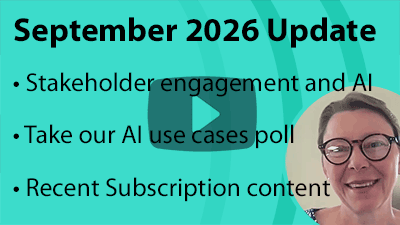
Read on the Blog:
September 2026 update
2nd September 2026
- Take our poll on AI use cases
8th September 2026 - September 2026 update
2nd September 2026 - All recent Subscription content
25th August 2026
- Jinfo Community session (TBC) (Community) 15th December 2026
- Jinfo Community session (TBC) (Community) 19th November 2026
- From AI use cases to implementation (Community) 22nd October 2026
Learn more about the Jinfo Subscription