 Balancing licensed content: on- versus off-platform
Jinfo Blog
30th April 2026
Abstract
Yet beneath that noise, a more practical – and arguably more consequential – question is taking shape: “Where should licensed content actually sit?”.
Item
For many organisations, the question of "on-platform" versus "off-platform" is no longer theoretical. It is a daily decision – often made incrementally – about whether to remain within vendor environments, or begin moving content beyond them.
Jinfo looks at this question in our new report "On- versus off-platform solutions – AI and licensed content".
On-platform: contained, visible, manageable – and restricted
On-platform approaches offer a certain kind of reassurance. There is clarity in how content is accessed and used, and a sense that governance is already defined.
In environments where compliance and auditability matter, that structure is not just helpful – it is essential. But it comes with trade-offs that are becoming harder to ignore.
Working within a single ecosystem can limit the use of content. It can restrict the ability to combine sources, connect internal knowledge, or experiment more freely with emerging AI use cases.
This is where off-platform approaches begin to appeal.
Off-platform: flexibility, own workflows, differentiation – and complex
By moving content into internal systems or third-party tools, organisations gain flexibility. They can shape workflows around their own needs, rather than adapting to those of a vendor.
It is here that many start to see the potential for differentiation.
But the shift is not without consequence. Flexibility introduces complexity – often quickly and at scale.
Licensing becomes less straightforward, costs can rise, and the effort required (to manage content properly) increases.
Responsibility also shifts. What was once handled by a provider, now sits internally: governance, compliance, and the risks that come with both.
And then there is the question that proves difficult to answer:
"Where does the value actually sit?"
- On-platform, usage is relatively easy to track and justify.
- Off-platform, value becomes embedded within broader processes, harder to isolate and harder still to measure.
It is perhaps for this reason that few organisations are making a clean choice.
Instead, a quieter pattern is emerging:
- On-platform for control, clarity and lower-risk workflows.
- Off-platform for flexibility, integration and exploration.
A blend, rather than a decision. It’s not a perfect model – but a pragmatic one.
And for now, that balance may be the most realistic way forward.
To understand the different approaches and our recommendations, read the Jinfo report: "On- versus off-platform solutions – AI and licensed content".
- Blog post title: Balancing licensed content: on- versus off-platform
- Link to this page
- View printable version
Register for our next Community session:

AI use cases in information management
22nd September 2026
Latest on our YouTube channel: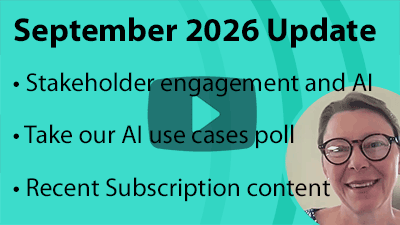
Read on the Blog:
September 2026 update
2nd September 2026
- Take our poll on AI use cases
8th September 2026 - September 2026 update
2nd September 2026 - All recent Subscription content
25th August 2026
- Jinfo Community session (TBC) (Community) 15th December 2026
- Jinfo Community session (TBC) (Community) 19th November 2026
- From AI use cases to implementation (Community) 22nd October 2026