 Be an agent of change, not a victim of circumstance – tips for information professionals
Jinfo Blog
9th April 2026
Abstract
- Be commercial
- Commit to lifelong learning
- Distinguish “Clients” from “Users”
- Embrace technology
- Build supplier partnerships
- Invest in peer networking.
Item
As I retire from a long and intensely satisfying career as an information professional, I have been asked for my top tips and reflections.
For me, the main piece of advice I would give is easy:
"Take control – be an agent of change and not a victim of circumstance."
Here's six things information professionals can, and should, do to take control:
1. Be commercial
I maintain that any team retained in a commercial organisation has three overarching aims:
- Grow the business – (make money)
- Optimise the business – (save money)
- Protect the business – (mitigate risk)
Everything you (and your teams) do must fulfil at least one of these outcomes.
Most teams are much smaller than the global team I ran, but they punch above their weight in terms of their contribution to the business.
So, take time to gather the evidence and document how you contribute to commercial impact.
2. "Every day is a school day"
Stay curious, be persistent, be proactive, and take responsibility for your own personal and professional development.
Many of you "know more than you think you do". Information professionals often have significant tenure and a depth of knowledge and experience – but it is important to stay open to new things and continue to learn and grow.
But, don't hesitate to mobilise that knowledge. Be courageous, take risks, act and be optimistic. Make conscious decisions to make things work out well and exercise meaningful agency over outcomes.
3. Know your "Clients" from your "Users"
I define "Users" as people that leverage your skills and capabilities, whereas "Clients" pay for them. Users may become Clients, and those Clients may continue to be Users. But it is an important distinction – however you choose to define it.
It is easy to get to know Users, but Clients are the most important stakeholders in your business. Senior leaders, budget-holders, and decision-makers are a vital cohort who can be difficult to reach but are vital to engage, they will have agency over your work and your team.
4. Get to grips with technology
Keep on top of technology – it is rarely the panacea claimed by some technologists.
Whilst I may not say this to technologists, I strongly believe that:
"You wouldn't want your plumber to be responsible for the quality of your water."
GenAI is the latest in a long list of technology disruptors of our industry. I remember when:
- "Dial up databases will make hard copy collections redundant"
- "The internet will make information ubiquitous"
- "Google will make everyone a researcher"
- "Machine learning and robotic process automation will transform information handling"
- "Semantic and natural language search will democratise information".
Most of these turned out to be true, but the technologies augment the work of researchers and information professionals – they don't replace it.
GenAI is the latest in a long line of "disruptive technologies." But managing, curating and using information is the domain of information professionals, and a vital role if technology investments are to deliver commercial benefits.
5. Partner your suppliers
Suppliers come and go, but the core ones have been around for many years ... including Jinfo (née FreePint)!
Our suppliers are more important than ever, and without them we wouldn't be here.
GenAI is reinforcing the need for these partnerships, driving up the need for greater collaboration and transparency:
- Information professionals need a better understanding of their suppliers' products
- Suppliers need more knowledge of business use-cases to licence products cost-effectively.
6. Meet your peers
Finally, I cannot overstate the value of networking.
The industry has a legacy of vibrant communities – AEBIG, City Information Group (CIG), SLA, the Business Information Conference, the European Business Information Conference, the annual Online Exhibition (IOLIM) and the Perfect Information Conference.
These groups and events provided vital opportunities to share experiences, the most productive way to pick up new insights, as well as useful reminders that you are not alone.
We are an increasingly small, but highly specialised community of subject matter experts. But groups like Jinfo, ASIS&T, CILIP, ALA, AALL, ALLA and BIALL – as well as events like the KIMRA conference – continue to offer these opportunities.
Closing thoughts
"If you fail to prepare, you are preparing to fail" is a phrase I use a lot, and I would augment it with a quote from Eisenhower:
"In planning for battle I have always found that plans are useless, but planning is indispensable."
This highlights that planning prepares you to adapt quickly, facilitates decisions and enables you to act quickly – even in the face of adversity.
If you follow the six steps above, you can plan for the future whilst remaining agile enough to adapt to changing circumstances in an increasingly volatile, uncertain, complex and ambiguous operating environment.
- Blog post title: Be an agent of change, not a victim of circumstance – tips for information professionals
- Link to this page
- View printable version
Register for our next Community session:
AI use cases in information management
22nd September 2026
Latest on our YouTube channel: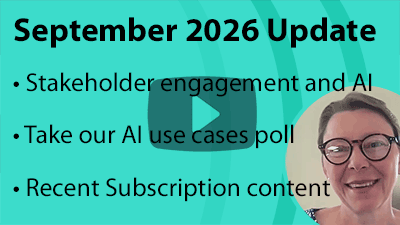
Read on the Blog:
September 2026 update
2nd September 2026
- Take our poll on AI use cases
8th September 2026 - September 2026 update
2nd September 2026 - All recent Subscription content
25th August 2026
- Jinfo Community session (TBC) (Community) 15th December 2026
- Jinfo Community session (TBC) (Community) 19th November 2026
- From AI use cases to implementation (Community) 22nd October 2026