Jinfo Blog
Receive these Blog items monthly, by signing up for the free newsletter:
 Automatic Classification: A Panel Discussion [ABSTRACT]
4th January 2009
The goal of automatic classification systems, whether rules-based or Bayesian, is to apply metadata in a way to make user access to content meaningful and scalable. Following their recent presentation on the topic to the International Society for Knowledge Organization UK (ISKO UK), Karen Loasby interviews fellow panelists Silver Oliver and Helen Lippell on the opportunities and challenges presented by automatic classification.
 Federated Search: A Year of Blogging [ABSTRACT]
4th January 2009
Blogging full time about a specific subject - in this case, federated search - has its share of ups and downs. Sol Lederman reflects on the ups and downs of his past twelve months as official blogger for vendor Deep Web Technologies, and shares what he's learned in the process.
 People Information: Finding Accurate, Authoritative and Well Organised Data [ABSTRACT]
4th January 2009
Although free information on people abounds on the Web, the quantity isn't always matched by quality. User-generated information, for instance, may skew accuracy, and verification can be tricky. Donna Fryer recommends revisiting the "Big Three" fee databases of Factiva, Dialog, and LexisNexis to be sure that the people data you use is reliable.
 2009 – the year of information liability?
 FIZ AutoDoc System updated
Register for our next Community session:

From AI use cases to implementation
22nd October 2026
Latest on our YouTube channel: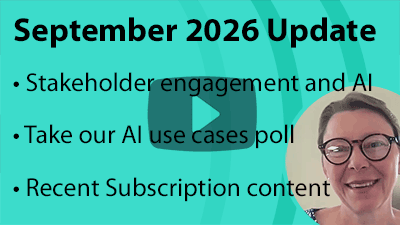
Read on the Blog:
September 2026 update
2nd September 2026
- AI use cases in information management – where are we today?
29th September 2026 - Take our poll on AI use cases
8th September 2026 - September 2026 update
2nd September 2026
- Jinfo Community session (TBC) (Community) 15th December 2026
- Jinfo Community session (TBC) (Community) 19th November 2026
- From AI use cases to implementation (Community) 22nd October 2026