 Should you sign up for a product in beta?
Jinfo Blog
13th January 2026
Abstract
To benefit safely, approach them strategically: test in controlled environments, protect your data, and treat participation as an experiment, not a long-term commitment.
Item
In Jinfo, we often come across products in beta. We enjoy engaging with these teams and giving them our feedback and advice on their products, target groups and market scope.
A product in beta is a test version released to a limited group of users to identify bugs and gather feedback before the full launch.
Innovation often comes with a trade-off between opportunity and risk. Products in beta sit firmly in that space, offering early access to promising tools and ideas, but accompanied by a fair degree of uncertainty.
The attraction of the beta: Early access, influence, and bragging rights
For many information managers, engaging with a product in beta can seem like a smart move:
-
It's a chance to get a better deal and early access to new features that could improve workflows or provide a competitive edge.
- Beta participants also gain a voice in shaping product direction, influencing the developers' roadmap before general release.
- There's a certain prestige in being among the first. You gain a reputation as a first mover, your team learns faster than others, and it can be genuinely enjoyable to explore a product’s potential while it’s still taking shape.
- The learning curve advantage means your users will be more experienced once the product matures. Some vendors even offer incentives, such as discounts, credits, or exclusive functionality.
The other side of the beta: Unfinished, uncertain, and fragile support
However, there’s another side to the story:
- A beta product is, by definition, unfinished. It may not deliver on every promise and that’s often why it comes at a lower price.
- You could spend weeks testing features only to find they don’t fit your organisation’s needs. Worse, the product could move in a direction you don’t support, or the vendor might even go out of business altogether.
- Security and privacy risks should also be top of mind. Beta software can include untested data handling processes, frequent updates that introduce bugs, and incomplete documentation.
- Compatibility issues may arise with existing systems, and integration breaks are common as developers refine APIs and connectors. Limited or inconsistent support can compound these challenges, leaving early adopters to troubleshoot on their own.
How to handle a beta invite
So how should an information manager approach a beta invitation? The key is to treat it as a structured experiment, not an operational deployment:
- Define your purpose. Why this vendor? What’s the real benefit?
- Isolate the environment. Test with non-critical user groups to contain any fallout.
- Protect your data. Use test accounts and anonymised datasets whenever possible.
- Read the fine print. Review terms and telemetry policies. Know what data is collected and how it’s used.
- Scope participation. Start small, gather metrics, collect user feedback, and expand only if the results justify it.
Ultimately, beta participation can be rewarding but only when approached with caution and clear boundaries.
For information managers, the goal isn’t just to be first; it’s to learn quickly, minimise risk, and ensure that innovation aligns with organisational priorities.
If you treat beta engagement as a learning opportunity, rather than a final solution, it can provide real strategic value and maybe even a little fun along the way.
See these related Jinfo Subscription resources:
- "Improve outcomes from your vendor negotiations"
- "Why information management skills are critical for managing data marketplaces"
- Contract negotiation role play – analysis and practical strategies for your negotiations
Have you come across a product in beta which you would like Jinfo to review? Let us know and we'll have a closer look.
- Blog post title: Should you sign up for a product in beta?
- Link to this page
- View printable version
Register for our next Community session:
AI use cases in information management
22nd September 2026
Latest on our YouTube channel: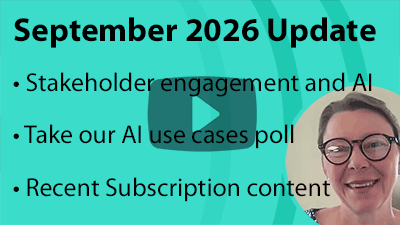
Read on the Blog:
September 2026 update
2nd September 2026
- Take our poll on AI use cases
8th September 2026 - September 2026 update
2nd September 2026 - All recent Subscription content
25th August 2026
- Jinfo Community session (TBC) (Community) 15th December 2026
- Jinfo Community session (TBC) (Community) 19th November 2026
- From AI use cases to implementation (Community) 22nd October 2026