 Into the lions’ den
Jinfo Blog
2nd April 2010
Item
Can you trust social media as a source of intelligence? Reuters has recently issued guidelines to its journalists implying that they canât afford to ignore them. âWe encourage the use of social media approaches in Reuters journalism,â says Dean Wright, who leads on standards for the news organisation. He also comments that some competitors have been âmore proscriptiveâ with their rules or guidelines (http://digbig.com/5bbgmf). He may have been thinking of the Financial Times, whose news editor Robert Shrimsley warned his journalists back in October 2008 that âI read it on Wikipediaâ would not play well as an excuse when confronted with a demand for a correction (http://www.vivavip.com/go/e14595). Wikipedia can be a good starting point for research, but should not be used as an attributable source, says the Reporting from the Internet section of Reutersâ Handbook of Journalism. So move on instead to official websites or other sources that are worthy of attribution (http://digbig.com/5bbgmg). Itâs good advice, and thereâs more. Clear such activity with your manager. Donât misrepresent yourself in a chat room or âpick locksâ in pursuit of information. Do a reality check on the information you glean from social sources. Is it within the bounds of what was expected? Information managers pondering the âfree vs feeâ dilemma may also want to take note of the Handbookâs strictures against Reuters journalists breaking news on Twitter. Break it first via Reutersâ proprietary channels, it says â âDonât scoop the wireâ. But if social media are OK sources for journalists, what about the rest of us? Last yearâs FreePint survey of news needs and preferences showed web versions of print products still earning by far the highest average rating among respondents, with independent professional blogs âa distant secondâ (report summarised in VIP magazine 72 â http://web.vivavip.com/go/shop/magazine/72 â or available to purchase in full at http://web.vivavip.com/go/shop/report/1524). Perhaps the Pew Research Centerâs State of the News Media report for 2010 helps explain why. Although the leading news stories in the blogosphere and on Twitter tend to differ substantially from the mainstream press, bloggersâ main sources are disappointingly predictable: the New York Times, CNN, the BBC (http://digbig.com/5bbgmh). But when it comes to niches, we all have our favourite experts. ContentBlogger (http://shore.com/commentary/weblogs/), Content Matters (http://www.contentmatters.info/) and Techcrunch (http://www.techcrunch.com) are among those favoured by LiveWire contributing editors, for instance. So what about yours? You could do worse than try Business Punditâs 75 Best Business Blogs of 2009 (http://digbig.com/5bbgmk) â featured recently in LiveWireâs sister publication ResourceShelf (http://digbig.com/5bbgmj) â or the 50 best business blogs highlighted by Strategist News last June (http://digbig.com/5bbgmm), to mention a couple. Or simply try a search in your chosen field on Google Blogs and â bearing in mind the Reutersâ Handbookâs good advice â see what happens.
What's new at Jinfo?
Register for our next Community session:

AI use cases in information management
22nd September 2026
Latest on our YouTube channel: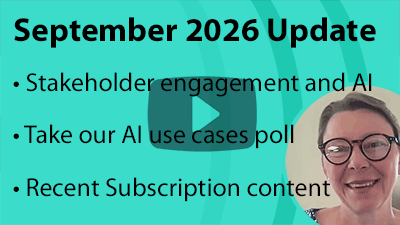
Read on the Blog:
September 2026 update
2nd September 2026
- Take our poll on AI use cases
8th September 2026 - September 2026 update
2nd September 2026 - All recent Subscription content
25th August 2026
- Jinfo Community session (TBC) (Community) 15th December 2026
- Jinfo Community session (TBC) (Community) 19th November 2026
- From AI use cases to implementation (Community) 22nd October 2026
Learn more about the Jinfo Subscription