 Expert profiling: connecting the experts
Jinfo Blog
15th July 2010
Item
As a researcher we are often called in to âjoin the dotsâ especially when it comes to finding people and experts. Building up a network of experts in a particular field, with all the obvious background details such as what they are working on, where they work and any partnerships and groups. In the past this job could be âmighty tediousâ especially when trying to discover experts from the academic sector. Then came an organisation called Collexis â the people behind AIP UNiPHY (http://digbig.com/5bcapa) and biomedexperts.com (http://digbig.com/5bcapb) . They developed an expert profiling platform and application that opened up a new kind of transparency in the scientific, technical and medical sector to allow researchers to connect. On the 13th July 2010 Collexis announced a new version of their âExpert Profilingâ - complete with a community platform. This allows researchers to connect across disciplines, but also across multiple institutions. Collexis (http://www.collexis.com/) is a developer of semantic and discovery technology and software. They recently became part of the Elsevier family (http://www.elsevier.com) of products in a buy-out concluded in June 2010 as reported in LiveWire (http://digbig.com/5bcapc). Prior to the acquisition of Collexis by Elsevier the profiles were generated using PubMed data (http://digbig.com/5bcany ). This is great content but limited in breadth of scope. Now the profiles are powered by the 18,000 peer review journals in the Scopus database. Scopus, reviewed last year in VIP (http://digbig.com/5bcanx) , has excellent content and great breadth of scope. This improves the profiles being generated not just in biomedical and life sciences but across all scientific disciplines. The community module could offer another âpower punchâ to this product. Now research experts from other institutions can be identified. This allows capability to find similar experts, grants and publications. I do have a caveat to add to this story based on my recent LiveWire article âWeb 2.0: just hype say researchers? (http://digbig.com/5bcapd). This type of technology is fantastic and you cannot fault the content - but there are issues. The most important content in these types of discovery products will be generated by the active participation of the authors and researchers. This is the real value added material and vendors cannot replicate or anticipate what it will be. This I believe is the barrier to the long term success of these products. But by developing a community platform this could be the key for more active participation by institutions - and consequently a better product.About this article
- Blog post title: Expert profiling: connecting the experts
- Link to this page
- View printable version
What's new at Jinfo?
Register for our next Community session:
AI use cases in information management
22nd September 2026
Latest on our YouTube channel: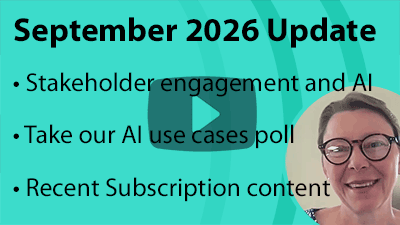
Read on the Blog:
September 2026 update
2nd September 2026
- Take our poll on AI use cases
8th September 2026 - September 2026 update
2nd September 2026 - All recent Subscription content
25th August 2026
- Jinfo Community session (TBC) (Community) 15th December 2026
- Jinfo Community session (TBC) (Community) 19th November 2026
- From AI use cases to implementation (Community) 22nd October 2026
Learn more about the Jinfo Subscription